
2026 Top 22kW Car Chargers for Home and Business
A 22kw Car Charger can look like an obvious upgrade: faster charging, a tidy wall-mounted unit, and a fuller battery by morning. But the 22 kW figure is a maximum, not a promise. Your vehicle’s onboard charger, the property’s electrical supply, and the installation all affect the power delivered. Some cars cannot accept 22 kW AC, even when the charger can provide it. Check the specifications before comparing prices.
EV charging specialist Tom Moloughney often emphasizes matching charging equipment to the driver’s needs. A fair paraphrase of that advice is: “Choose a charger your car and electrical supply can actually use.” It is a practical reminder, not a substitute for checking product documentation or getting a qualified assessment of the site. For a home, consider daily mileage, cable reach, weather exposure, and where the car is parked. For a business, factor in driver turnover, access, and the number of vehicles charging at once.
Details matter. A compact unit beside a garage door may suit one household; a shared parking area may need load management and clear user controls. This guide compares 22 kW home and business chargers by features, compatibility, installation considerations, and value. Ratings alone can mislead. Product availability, included cables, and support also vary by market, so verify current specifications before buying.
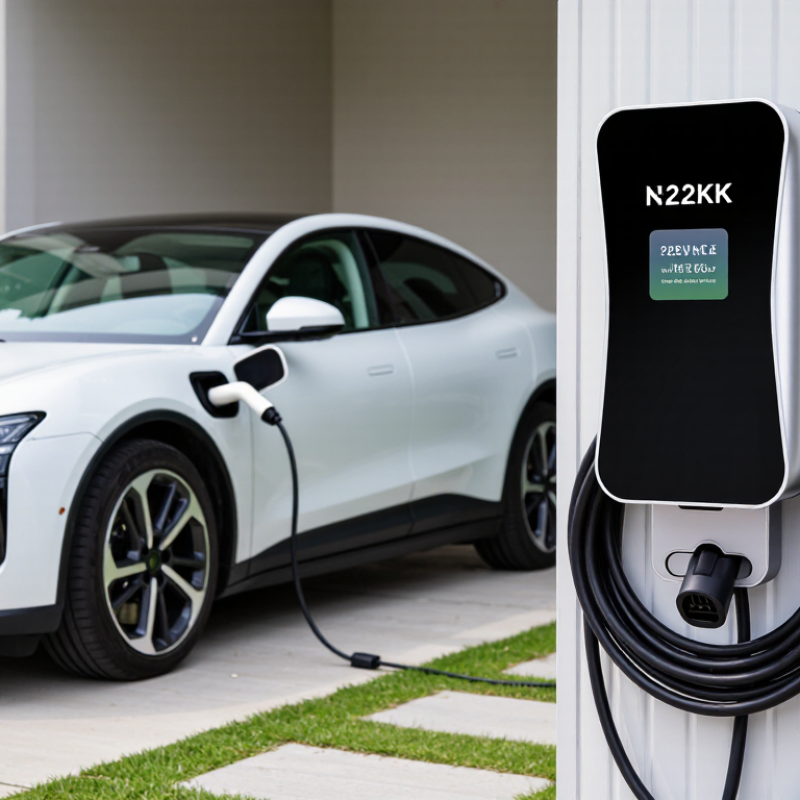
What Defines a 22 kW Car Charger?
A 22 kW car charger is an AC charging unit capable of delivering up to 22 kilowatts under suitable conditions. Most home units reach that rating through three-phase power at roughly 400 volts and 32 amps per phase. The figure describes the charger’s maximum output, not a promise that every car will receive 22 kW. The vehicle’s onboard charger sets another limit. Some cars accept only 7.4 or 11 kW on AC, so a larger unit may not shorten their charging time. A quick check.
In practice, the useful rate also depends on the electrical supply, cable, temperature, and available site capacity. Adding about 22 kWh in an hour is a rough ideal, before conversion losses and charging controls. A qualified installer should assess the circuit, phase availability, protective devices, and load management. Business sites may need several charging points, where smart load sharing helps keep demand within the building’s capacity. Details matter. The headline number is useful, though easy to overvalue; charging rates can fluctuate, and one session may not reflect typical performance.
2026 Top 22kW Car Chargers for Home and Business - What Defines a 22 kW Car Charger?
| Feature | What to Know About a 22 kW AC Charger | Home Considerations | Business Considerations |
|---|---|---|---|
| Rated charging power | Up to 22 kW of AC power, subject to the vehicle, supply, installation, and operating conditions. | Often more power than needed for overnight charging; check the household’s available electrical capacity. | Can suit workplaces, fleets, and destinations where vehicles need a faster AC top-up between longer stays. |
| Typical electrical supply | Commonly three-phase AC at about 400 V and 32 A per phase in regions using this supply arrangement. Actual requirements vary by local electrical standards. | A suitable three-phase connection and correctly rated circuit are generally needed for full output. | Have an electrician assess the incoming supply, distribution board, and capacity for simultaneous charging. |
| Vehicle compatibility | The vehicle’s onboard AC charger sets the maximum AC charging rate. A 22 kW EVSE cannot make a vehicle accept 22 kW if its onboard charger supports less. | Check the vehicle manual or specification for its maximum AC input and connector type. | Check the connector and vehicle mix expected at the site before choosing equipment. |
| Connector and region | Connector standards and supply voltages differ by market. Type 2 is widely used for AC charging in Europe and other regions, but is not universal. | Select equipment that matches local regulations and the vehicle’s inlet. | For shared sites, consider the connector standard used by the local vehicle fleet and any applicable accessibility requirements. |
| Illustrative charging time | At a full 22 kW, 60 kWh of energy would take about 2.7 hours in a simple energy ÷ power calculation. Real charging can take longer because of conversion losses, vehicle limits, and charging behavior. | Actual time depends on the energy needed, the car’s AC limit, and the usable charging window. | Use expected dwell time and vehicle charging limits to estimate how many charging points are needed. |
| Power management | Load management can adjust charging power to help keep total site demand within a configured limit. | Dynamic load balancing may help coordinate charging with household loads, where supported and properly installed. | Load management can help distribute available capacity across multiple charging points; it does not increase the site’s electrical supply. |
| Installation and protection | Installation should follow local electrical codes and the equipment instructions, including appropriate circuit protection, earthing, and isolation. | Ask a qualified installer to assess cable routing, mounting location, and the existing electrical installation. | Plan for site assessment, permits where required, protective devices, and inspection or commissioning requirements. |
| Indoor and outdoor use | Enclosure ratings and operating limits vary by model. Confirm suitability for the intended location rather than assuming every unit is weatherproof. | Check the installation location, exposure to weather, cable reach, and manufacturer-specified temperature range. | Consider exposure, impact risk, cable management, and the maintenance needs of a shared charging area. |
| Connectivity and access | Depending on the model, features may include app connectivity, scheduled charging, access control, or energy reporting. | Choose controls that fit how the household will use the charger; connectivity features may require a network connection. | For shared use, confirm user access, payment or billing needs, data handling, and network availability. |
| Best-fit use case | A 22 kW AC charger is most useful when the vehicle can accept high-power AC and the site has suitable electrical capacity. | Consider it when faster AC charging is valuable and three-phase power is available; a lower-power charger may be sufficient for routine overnight charging. | Consider it for longer-stay parking and fleet use where compatible vehicles can benefit from higher AC power. |
Note: A 22 kW rating describes the EVSE’s maximum AC output, not a guaranteed charging rate. Actual charging power depends on the vehicle’s onboard charger, electrical supply, installation, and operating conditions. Consult a qualified electrician and local requirements before installation.