
2026 Top Types of Magnet Motor Generators for Global Buyers
Choosing the right magnet motor generator in 2026 requires more than comparing advertised output. Global buyers must examine topology, operating speed, cooling design, magnet grade, control systems, and verified efficiency. Common choices include radial-flux permanent magnet generators, axial-flux models, low-speed direct-drive units, and high-speed generators paired with gearboxes. Each design suits different conditions.
Professor Thomas A. Lipo, a respected electrical-machines researcher, has emphasized that permanent-magnet machines provide “high efficiency and high power density.” That principle remains useful, but it is not the whole story. A compact generator may perform well in a laboratory and struggle in a dusty factory. A direct-drive unit can reduce gearbox maintenance, yet its larger magnets may raise purchase and replacement costs. Small details matter.
This guide reviews the top types of magnet motor generator systems for wind, micro-hydro, backup power, and industrial applications. It considers rated power, starting torque, voltage stability, thermal behavior, service access, and supplier documentation. Buyers should request test reports, load curves, material specifications, warranty terms, and clear installation limits. “High efficiency” needs a test method. “Maintenance-free” needs skepticism.
Performance depends on the complete system. Poor alignment, excessive heat, or unsuitable controllers can reduce output quickly. Global projects also face different grid requirements, climates, and transport conditions. Some classifications remain inconsistent across suppliers. That is a weakness worth admitting. Careful comparison helps buyers avoid exaggerated claims and select equipment that performs reliably in real operating environments.
What Magnet Motor Generators Are and How They Produce Electricity
What Magnet Motor Generators Are and How They Produce Electricity
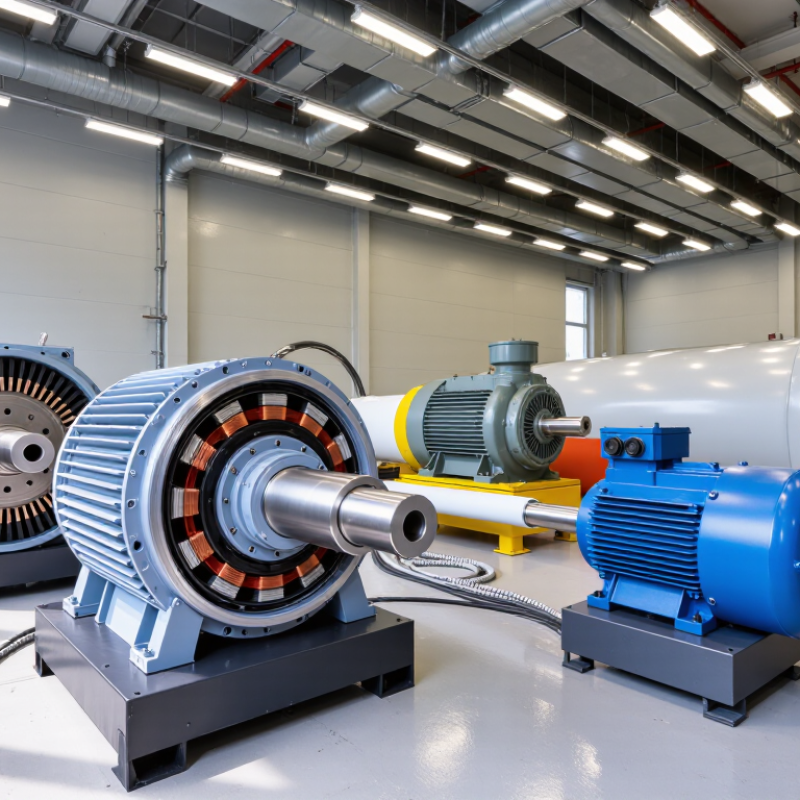
Magnet motor generators convert mechanical motion into electrical power through electromagnetic induction. A rotating magnetic field passes the stator coils, forcing electrons to move. This process follows Faraday’s law. No mystery. The engine, turbine, or water wheel supplies the motion.
The main types include radial-flux permanent-magnet generators, axial-flux designs, and hybrid-excitation generators. Radial-flux units suit many wind and industrial systems because their structure is proven and scalable. Axial-flux models are flatter, lighter, and useful where installation space is limited. Hybrid systems combine permanent magnets with electrical excitation, offering better voltage control under changing loads. Direct-drive permanent-magnet generators can reduce gearbox losses, but their magnets may increase material costs and supply risks. That trade-off deserves closer attention.
IRENA reported 585 GW of renewable capacity additions in 2024, lifting global capacity to about 4,448 GW. This growth increases demand for efficient generator technologies. The International Energy Agency also expects renewable capacity to expand by nearly 5,500 GW between 2024 and 2030. These figures suggest strong opportunity, but market forecasts are not installation guarantees.
Tips: Check rated speed, voltage regulation, cooling, and operating temperature before buying. Ask for measured efficiency curves, not only peak efficiency. Confirm magnet composition and maintenance access. A compact generator may look attractive, yet poor cooling can shorten its working life. Industry reports guide decisions, but site data should decide them.
2026 Top Types of Magnet Motor Generators for Global Buyers - What Magnet Motor Generators Are and How They Produce Electricity
| Generator Type | Magnetic and Electrical Design | Typical Speed Range | Typical Power Range | Typical Efficiency | Common Applications | Main Advantages | Important Buying Considerations |
|---|---|---|---|---|---|---|---|
| Radial-Flux Permanent Magnet Generator | Conventional cylindrical rotor and stator arrangement. Permanent magnets create the rotor field, while rotating motion induces alternating current in the stator windings. | Approximately 300–3,600 rpm, depending on pole count and frequency requirements. | About 1 kW–5 MW in commercial and industrial configurations. | Approximately 90%–97% at rated load. | Wind turbines, hydro systems, backup generation, marine equipment, and industrial prime movers. | Mature construction, strong power density, good voltage regulation with suitable power electronics, and broad supplier availability. | Check cooling method, magnet grade, insulation class, overspeed rating, bearing life, and compatibility with the intended mechanical speed. |
| Axial-Flux Permanent Magnet Generator | Flat disc-shaped rotor and stator arrangement. Magnetic flux travels mainly along the shaft axis, allowing a compact and short machine. | Approximately 100–3,000 rpm, depending on design and application. | About 500 W–1 MW, with larger systems available for specialized projects. | Approximately 88%–96% at rated load. | Small wind turbines, compact hydro units, electric vehicle systems, test equipment, and space-constrained installations. | High torque density, compact axial length, and suitability for direct-drive low-speed systems. | Evaluate rotor balancing, air-gap control, thermal management, structural stiffness, and maintenance access. |
| Low-Speed Direct-Drive PM Generator | A high-pole-count permanent magnet synchronous generator designed to connect directly to a slow prime mover without a gearbox. | Approximately 10–300 rpm. | About 1 kW–10 MW, depending on the mechanical system. | Approximately 90%–96% at rated load. | Direct-drive wind turbines, tidal generators, low-head hydro, wave-energy equipment, and large rotating machinery. | Eliminates gearbox losses and gearbox maintenance while providing strong low-speed torque production. | The generator is usually larger and heavier than a geared alternative. Confirm starting torque, transport limits, grid converter rating, and service access. |
| High-Speed PM Generator | A permanent magnet rotor optimized for high rotational speed, commonly coupled to a turbine or other high-speed prime mover. | Approximately 3,000–30,000 rpm, depending on rotor construction and application. | About 10 kW–5 MW. | Approximately 92%–98% at rated load. | Microturbines, turbo-generators, compressors, aerospace support equipment, and high-speed industrial systems. | High power density, compact size, and efficient operation when matched to a high-speed engine or turbine. | Review rotor mechanical strength, containment protection, balancing grade, bearing system, cooling, and maximum overspeed. |
| Permanent Magnet Motor-Generator Set | A reversible electric machine can operate as a motor when supplied with electricity and as a generator when driven mechanically by an external prime mover. | Approximately 500–6,000 rpm, depending on the motor-generator design. | About 1 kW–2 MW. | Approximately 90%–97% in motor or generator operation near rated load. | Regenerative braking, energy storage systems, laboratory test benches, hoists, elevators, and hybrid powertrains. | Supports bidirectional energy flow, precise speed control, and regenerative operation through an appropriate inverter. | It cannot create energy without mechanical input. Select the inverter, control system, duty cycle, thermal capacity, and braking arrangement together. |
| Permanent Magnet Wind Generator | Usually a radial-flux or axial-flux permanent magnet generator connected to a wind turbine and power converter. | Approximately 10–500 rpm for direct-drive systems; geared systems operate at higher generator speeds. | About 300 W–15 MW, depending on turbine scale. | Approximately 90%–97% for the generator at rated load. | Residential, agricultural, off-grid, community, and utility-scale wind energy systems. | Good efficiency across variable speeds, reduced maintenance when direct-drive, and suitability for variable-speed operation. | Assess wind-resource data, cut-in and rated wind speed, storm protection, converter requirements, noise limits, and tower compatibility. |
| Permanent Magnet Hydro Generator | A permanent magnet synchronous generator coupled to a water turbine, often configured for variable-speed and direct-drive operation. | Approximately 50–1,500 rpm, depending on water head, flow rate, and pole count. | About 1 kW–10 MW. | Approximately 90%–98% at rated load. | Micro-hydro, small hydro, run-of-river plants, irrigation channels, and tidal-current systems. | Efficient low-speed generation, strong starting torque, and reduced gearbox requirements. | Confirm water head and flow profile, corrosion protection, submergence conditions, debris protection, civil-work interfaces, and grid connection. |
| Small Portable PM Generator | Compact permanent magnet alternator driven by an internal-combustion engine, hand crank, bicycle, water turbine, or other small mechanical source. | Approximately 1,000–3,600 rpm for engine-driven units; lower speeds are possible with suitable pole counts. | About 100 W–20 kW. | Approximately 75%–92% for the generator section at rated load. | Camping, emergency power, telecom backup, mobile work sites, educational equipment, and small off-grid systems. | Lightweight, low maintenance, suitable for battery charging, and capable of producing power at variable speed with a rectifier or inverter. | Check continuous versus peak output, cooling, noise, enclosure rating, waveform quality, battery compatibility, and replacement-part availability. |
Technical note: A magnet motor generator uses permanent magnets to establish a magnetic field, but the magnets do not provide an unlimited energy source. Electricity is produced only when an external mechanical input—such as wind, water, an engine, a turbine, or a motor—rotates the generator. Actual output, speed, and efficiency depend on the specific design, load, cooling system, power electronics, and operating conditions.
Related Posts
-

Exploring the Future of Energy with Permanent Magnet Motor Generators
-
Why Choose a Permanent Magnet Motor Generator for Your Needs?
-
Top Benefits of Using Permanent Magnet Motor Generators for Efficient Energy Conversion?
-

Top China Best Permanent Magnet Motor Generator for Global Buyers?
-

What is a Magnet Motor Generator and How Does It Work?
-
Why is PMSM Motor the Best Choice for Electric Vehicles Performance