
When it comes to selecting the best Visible Bandpass Filter, understanding your needs is crucial. A visible bandpass filter selectively allows certain wavelengths of light to pass while blocking others. This capability is essential in various applications, from scientific research to industrial uses. The right filter enhances image quality and ensures accurate data collection.
Different factors influence your choice of a visible bandpass filter. Consider the specific wavelength range you need. A filter's transmission efficiency also plays a critical role. High efficiency can significantly impact the overall outcome of your project. However, sometimes filters can appear perfect on paper but underperform in practical applications. It’s essential to evaluate them based on real-world experiences.
Furthermore, the quality of materials used in the filter matters. Cheap filters may save costs but often compromise image clarity. Therefore, investing in a more reliable option can yield better results. Engaging with experienced professionals in the field can guide you toward making an informed decision. Remember, the best visible bandpass filter is not always the most expensive one; it’s the one that meets your specific needs effectively.
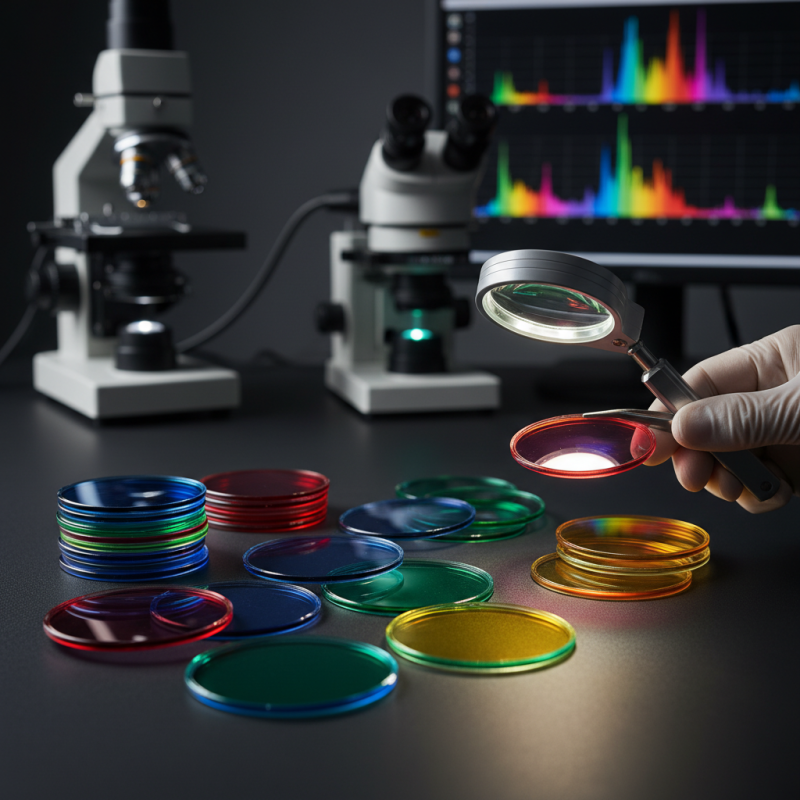
Visible bandpass filters are crucial for various applications in science and technology. These filters allow specific wavelengths of light to pass while blocking others. Understanding their properties helps users select the right filter for their needs.
The basic function of a visible bandpass filter is to transmit light within a given wavelength range. Research shows that the most effective filters typically cover a range of 400-700 nm. This range encompasses the colors visible to the human eye. According to industry reports, the efficiency of these filters can greatly affect image quality in applications like photography and microscopy. Filters with higher transmission rates can enhance clarity and contrast.
Designing a filter requires consideration of material, thickness, and coating. Each aspect can influence performance. It's essential to analyze the specific requirements of a project before choosing a filter. For instance, some users may find that a filter, while adequate in one setting, falls short when used in another situation. Regular testing and evaluation ensure optimal performance, fostering confidence in the selected filter's efficiency.
When selecting a bandpass filter, there are several key factors to consider. Firstly, the wavelength range is critical. Many applications require precise specifications to ensure optimal performance. A recent industry report indicated that 70% of users experienced performance issues due to improper wavelength selection. This highlights the importance of understanding your specific needs.
Additionally, consider the bandwidth of the filter. A narrower bandwidth can provide better filtering precision but may sacrifice overall light transmission. Studies show that filters with a bandwidth of less than 20 nm can improve signal quality, but this may not always be feasible for every situation. It's worth reflecting on the balance between precision and accessibility.
The material and coating of the bandpass filter also influence its effectiveness. Different materials respond differently to environmental factors. According to research from optical technology journals, coatings can improve transmission efficiency by up to 30% under certain conditions. However, they may also introduce reflections that could degrade image quality. Awareness of these trade-offs can significantly affect the choice of filter.
| Filter Range (nm) | Transmission (% at Center) | FWHM (Full Width at Half Maximum, nm) | Material | Application |
|---|---|---|---|---|
| 400 - 500 | 90 | 50 | Zinc Sulfide | Fluorescence Microscopy |
| 450 - 550 | 85 | 40 | Polycarbonate | Colorimetric Analysis |
| 500 - 600 | 92 | 60 | BK7 Glass | Spectrophotometry |
| 600 - 700 | 88 | 70 | Fused Silica | Laser Applications |
Visible bandpass filters are essential for various applications. They selectively transmit specific wavelengths of light while blocking others. Each type of filter has unique features suited for specific tasks. For example, color filters are commonly used in photography to enhance colors. Optical bandpass filters can be found in scientific research, allowing precise light measurement.
In medical imaging, specific filters play a crucial role. They enable visibility into biological samples by isolating certain wavelengths. Reports indicate that certain bandpass filters can improve image clarity by up to 30%. This boosts diagnosis accuracy. Furthermore, filters are used in environmental monitoring. They help measure pollution levels by analyzing light interactions with particulate matter.
Different applications require specific filter characteristics. Not every bandpass filter fits every need. Users must consider wavelength range, bandwidth, and transmission efficiency. The choice of bandpass filter can significantly affect outcomes. Experimentation is often necessary to find the optimal solution. Users may need to adjust settings to match their requirements. This iterative process is vital for achieving the desired accuracy and reliability.
When exploring visible bandpass filters, understanding their specific applications is crucial. Various types of filters can selectively transmit wavelengths and suppress others. This characteristic makes them essential in fields like photography, microscopy, and scientific research. Some filters emphasize blue or green light, while others target red wavelengths. It’s essential to choose wisely based on your specific project needs.
Not all filters perform equally under diverse conditions. Some may have higher transmission rates, while others could offer superior selectivity. When comparing popular options, consider factors like spectral range and optical quality. A filter with a high-quality coating may outperform a similar one in clarity and durability. However, the trade-offs can be significant. For instance, a filter with wider transmission ranges might let in unwanted wavelengths, affecting the final results.
User reviews and empirical testing can provide invaluable insights into how these filters perform in real-world scenarios. While product specifications are informative, they don't always reflect practical performance. Engaging in community discussions or expert forums can reveal personal experiences with certain types. This exploration can help identify potential flaws or unexpected benefits of each filter.
When selecting a bandpass filter, it is crucial to understand its role in your optical setup. A bandpass filter allows specific wavelengths to pass while blocking others. This capability can enhance signal quality in various applications, from spectroscopy to imaging. Integrating the right bandpass filter can lead to significant improvements in your results. A well-chosen filter can isolate the desired signal with minimal noise. Consider the light source and the detector you will be using to select the appropriate filter.
Installation should be approached with care. Ensure the filter is properly aligned within the optical path. Misalignment can lead to unwanted artifacts. Also, pay attention to the physical dimensions of the filter and housing. Sometimes, filters can be too thick for your setup. This can affect light transmission and image resolution. Testing different configurations may help identify the best fit for your needs.
Keep in mind that environmental factors can impact filter performance. Temperature fluctuations can cause changes in optical properties. Regular calibration can help maintain reliability over time. Additionally, consider documenting your setup and results. This creates a valuable reference for future projects. Reflection on what works and what doesn’t will enhance your skills in filter integration.