What Is the Best Wpc Exterior Panel from China?
Choosing the best Wpc Exterior Panel from China requires more than comparing prices, colors, or surface textures. A reliable choice begins with actual application conditions. Will the panel face strong sunlight, coastal moisture, freezing temperatures, or frequent cleaning? These details can change the right specification completely. A panel that performs well on a sheltered balcony may fail on an exposed commercial façade.
Dr. Jerrold E. Winandy, a respected wood-composites researcher, offers a useful principle: “Performance must be judged in the intended use, not in isolation.” This idea matters when evaluating Chinese Wpc Exterior Panel manufacturers. Buyers should examine wood-plastic ratios, resin type, profile density, water absorption, color stability, fastener compatibility, and production consistency. Factory experience also matters. Ask for batch records, technical datasheets, installation instructions, and independent test reports. Check samples under real light.
Looks can mislead.
A convincing grain pattern does not prove long-term durability. Likewise, a high recycled-content claim does not automatically indicate poor quality. It may show responsible material planning, if manufacturing controls remain stable. Fire performance also requires careful review, because local building requirements differ by project and location. Some products may need additional testing before approval. I would not call one Chinese panel universally “the best.” That answer is too simple. The stronger question is whether a specific Wpc Exterior Panel matches the building, climate, budget, and maintenance plan. This guide will compare those practical factors and highlight where attractive specifications still deserve closer inspection.
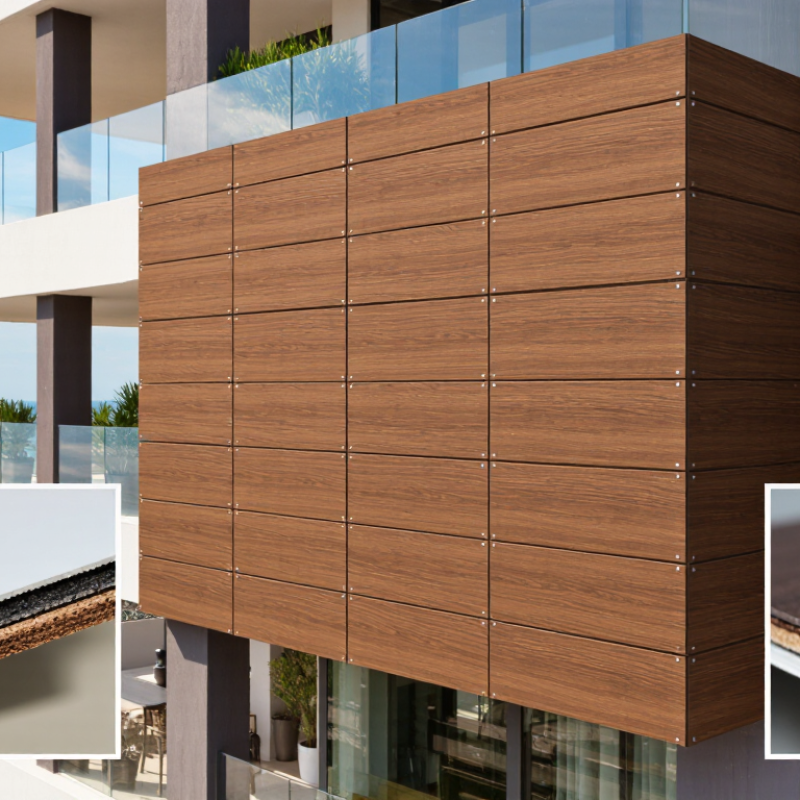
What Is a WPC Exterior Panel and How Is It Made in China?
WPC exterior panels combine wood fiber or flour with thermoplastic materials, such as polyethylene or polypropylene. The blend creates a surface that resembles timber but resists moisture better. These panels suit façades, balconies, garden walls, and screened outdoor areas.
In China, production usually begins with drying and screening the wood material. Moisture control matters. Too much water can cause bubbles, weak bonding, or surface cracks. Manufacturers then mix the wood content with plastic resin, pigments, stabilizers, and processing additives. The heated mixture passes through an extrusion line, where pressure forms the panel profile. Cooling calibrators control thickness and shape. Embossing rollers add a grain pattern, while cutting equipment produces consistent lengths.
Quality is not automatic. I would inspect the panel’s density, screw-holding strength, water absorption, color stability, and thermal movement. Samples should face repeated wetting, drying, heating, and cooling. A good supplier can provide production records and independent test reports. Still, laboratory results may not match a poorly installed wall. Ventilation gaps, stainless fixings, and correct spacing remain important.
The process has imperfections. Natural fibers can create small color variations, and darker panels may heat significantly in direct sunlight. Some surfaces also become less uniform after long exposure. For that reason, buyers should compare physical samples, installation instructions, and test data before selecting a Chinese WPC exterior panel.
What Is the Best WPC Exterior Panel from China?
Typical material composition of a WPC exterior panel
WPC exterior panels are commonly manufactured from wood flour or fiber blended with a thermoplastic polymer, such as polyethylene or polypropylene, plus additives. A typical reference formulation contains about 50% wood fiber, 40% polymer, and 10% additives. The actual recipe may vary according to weather resistance, strength, surface finish, and processing requirements.
How Do Chinese WPC Exterior Panels Compare in Performance?
Chinese WPC exterior panels can deliver dependable performance when their formulation and production controls are consistent. The strongest panels usually combine recycled wood fiber, durable polymers, UV stabilizers, and moisture-resistant additives. In practical installations, they resist rot, insects, and surface cracking better than untreated timber. However, “WPC” is not a single quality standard. Density, fiber content, and extrusion accuracy can vary considerably.
Against traditional wood, Chinese WPC panels generally require less painting and show better resistance to rain and humidity. Their stable surfaces suit balconies, garden walls, façades, and shaded outdoor spaces. Color fading remains possible under strong sunlight, especially with dark finishes. Thermal expansion also needs attention. Small gaps matter. Installers should allow movement around joints and use suitable fasteners. A poorly planned system can warp, even when the panel itself is well made.
Performance comparisons should include water absorption, flexural strength, screw-holding capacity, UV aging, and slip resistance where relevant. Independent test reports provide more useful evidence than attractive product photographs. Local climate matters too. Coastal salt air, freezing winters, and intense heat can expose weaknesses quickly. Fire behavior and installation details should meet the requirements of the intended market. It is not perfect. Some panels feel less natural than real wood, and hidden support problems may appear months later. A careful sample inspection, documented testing, and a small trial installation offer stronger confidence than price alone.
How Should WPC Exterior Panels Be Selected and Installed?
What Is the Best WPC Exterior Panel from China?
The best WPC exterior panel is not simply the cheapest option. Selection should begin with climate, wall exposure, and verified test results. Check the wood-plastic ratio, density, water absorption, fire rating, and ultraviolet resistance. A panel near the coast needs stronger moisture protection and corrosion-resistant fixings. A dark panel may also expand more under direct sunlight.
The 2023 UNEP Global Status Report for Buildings and Construction states that buildings produced 37% of global energy and process-related carbon emissions in 2022. Durable cladding can reduce replacement waste, but only when its service performance is documented. Ask for test reports based on recognized methods, such as ASTM D7031 for wood-plastic composite performance and ASTM D1435 for outdoor weathering. Test data is useful. It is not a guarantee for every building.
Tips: Inspect panels for consistent color, straight edges, and clean extrusion lines. Store them flat, raised above wet ground, and protected from sunlight. During installation, keep the required ventilation cavity behind the panels. Use the specified clips or screws, and leave movement gaps at joints and corners. Do not force a tight fit. Allow for thermal expansion. Fixings should enter a sound substructure, not only the panel skin. Check alignment every few rows with a level. Small installation errors can become visible after temperature changes. I would also request a sample and expose it outdoors before ordering a large quantity; laboratory results alone may not reveal every practical weakness.