
How to Choose a Fufu Mixer Machine in 2026?

Choosing a Fufu Mixer Machine in 2026 involves more than comparing motor power or price. The machine must handle the actual texture, batch size, and working rhythm of your kitchen or production site. FAO’s report Save and Grow: Cassava (2013) notes that cassava is a staple food for more than 800 million people worldwide. That scale makes reliable processing important, but it does not mean every mixer suits every fufu recipe. A machine that works well with one cooked cassava blend may struggle with a thicker yam mixture.

Start with the details you can observe. How many kilograms will you process per batch? Does the bowl allow you to inspect the mixture without stopping? Can the paddles reach its edges? These practical checks matter. So do cleaning access, spare-part availability, and the manufacturer’s stated duty cycle. FAO and WHO’s Codex General Principles of Food Hygiene (CXC 1-1969, revised 2022) provide a useful reference for hygienic food handling and equipment design. Ask suppliers how their machine’s food-contact surfaces can be cleaned and maintained. Then request a demonstration using your ingredients, not just an empty-bowl test.

Be cautious with dramatic capacity claims. Published specifications may not reflect your recipe, operator skill, or power supply. There is no single performance figure that proves a Fufu Mixer Machine is right for every buyer. A short trial can reveal awkward controls, uneven mixing, or cleanup problems that a brochure misses. Some uncertainty remains; that is a reason to verify, not guess.
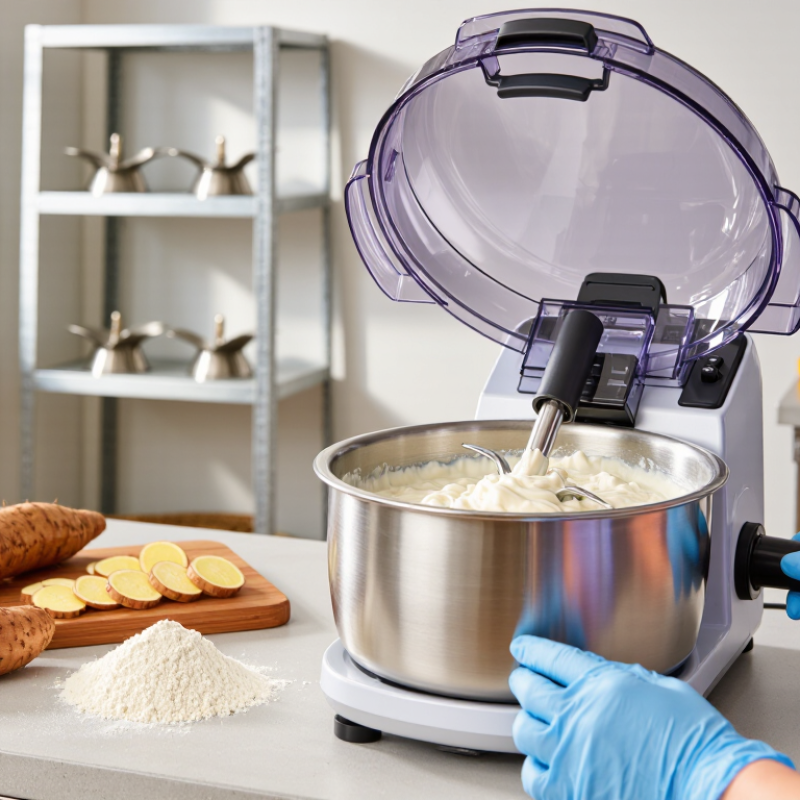
How to Choose a Fufu Mixer Machine in 2026?

Identify Fufu Type, Daily Output (kg/h), and Batch Size (kg)

Choose a mixer around the fufu you actually make, not a generic capacity label. Fermented cassava mash, cooked cassava, and plantain blends behave differently under mixing. Fresh cassava also carries substantial water. FAO’s Roots, Tubers, Plantains and Bananas in Human Nutrition reports that cassava roots typically contain about 60–70% moisture. That changes the weight and texture entering the mixer. Texture matters. Ask suppliers to test your own ingredients and document the resulting consistency, mixing time, and usable batch weight.

Calculate hourly output from your daily target and available production hours. If you need 480 kg in six operating hours, the line must average 80 kg per hour, including normal pauses. An eight-hour shift rarely means eight hours of mixing. Allow time for loading, unloading, cleaning, and changeovers. FAOSTAT records more than 330 million tonnes of global cassava production in 2022, but that broad crop figure cannot predict a local plant’s demand. Treat rated throughput as a starting point, not a promise. Run a trial. Record how a half-full batch compares with a full one; the result may be less even than expected.

Match Motor Power (kW) and Mixing Speed (rpm) to Dough Load

When choosing a fufu mixer, match motor power to the heaviest dough batch you actually make, not the bowl’s advertised capacity. A dense, sticky cassava mixture can demand high torque even at low speed. Check whether the stated kW rating is continuous-duty power, and ask for the mixer’s output torque under load. The U.S. Department of Energy’s guide, Determining Electric Motor Load and Efficiency, notes that motor efficiency often peaks near 75% load and can fall notably below 50%. A motor that is consistently oversized may therefore be a poor fit. Check the duty cycle, too.

Speed needs equal care. The relationship T = 9550 × kW ÷ rpm estimates shaft torque in newton-metres, before gearbox losses. For example, 1.5 kW at 30 rpm gives about 478 Nm at the motor shaft; a reducer changes output speed and torque. Ask suppliers for loaded output rpm, not just the motor’s nameplate speed. A slow, powerful setting may knead a firm batch steadily, while excessive speed can splash softer mixtures and strain the drivetrain.

Test a small batch. Record batch weight, water ratio, mixing time, and motor temperature. These details make comparisons useful, though they will not capture every variation in cassava texture.

Verify Food-Contact Materials Under EU Regulation 1935/2004

How to Choose a Fufu Mixer Machine in 2026?
Verify Food-Contact Materials Under EU Regulation 1935/2004

A powerful motor matters, but every surface touching fufu deserves equal attention. Check the bowl, mixing blade, shaft, and seals. Ask what each part is made from and request documents identifying its intended food-contact use. EU Regulation 1935/2004 sets a framework: materials must not transfer substances that could endanger health or unacceptably change food’s composition, taste, or smell under normal or foreseeable conditions. Small details matter.

Ask suppliers for relevant declarations and supporting information, including migration-test results where applicable. The right evidence depends on the material and its use; plastics, for example, may also fall under specific EU measures. Check that the documents match the exact parts, food type, contact time, and processing temperature—not simply a similar machine. Look closely at joints and seals, where residue can collect after mixing. A smooth-looking surface is not proof of compliance. Paperwork can appear complete yet leave questions about a replacement gasket or a different cleaning routine. That deserves a follow-up. Compare the machine’s stated cleaning instructions with your actual process, and retain material and traceability records for future checks.

How to Choose a Fufu Mixer Machine in 2026? - Verify Food-Contact Materials Under EU Regulation 1935/2004

Inspection Area What to Verify Useful Evidence or Questions Warning Sign
Food-contact parts Identify every surface that may contact fufu, water, or ingredients, including the bowl, paddle, shaft, scraper, seals, and gaskets. Request a parts list that names the material for each food-contact component. Check that the documents cover the supplied machine configuration. The seller describes the machine as “food grade” but cannot identify the materials or the parts covered.
EU Regulation 1935/2004 The framework regulation requires food-contact materials to be sufficiently inert: they must not transfer constituents in amounts that could endanger health, cause an unacceptable change in food composition, or impair its organoleptic characteristics. Ask for a written, product-specific compliance statement and supporting technical documents explaining how the intended food-contact use is addressed. A generic claim or certificate is offered without identifying the product, contact parts, or intended conditions of use.
Plastic components For plastic food-contact parts, check whether the applicable requirements of EU Regulation 10/2011 are addressed in addition to the framework regulation. Request the applicable Declaration of Compliance and supporting migration-test information. Confirm the tested material, food type, contact time, and temperature are relevant to use. A test report covers a different plastic, food type, or use condition from the part being supplied.
Metal parts For bowls, paddles, and shafts, verify the specified metal grade and whether coatings, welds, or surface treatments are present. Ask for material specifications and food-contact suitability evidence for the actual alloy and finished surface. Consider the food’s acidity, temperature, and contact duration. The response gives only “stainless steel” without a grade, or does not address coatings and surface condition.
Seals and flexible parts Check seals, gaskets, and flexible scrapers that can contact food, including their material and stated temperature limits. Request documentation for the exact compound and intended use. Confirm that replacement parts have the same documented food-contact suitability. Seals are undocumented, difficult to identify, or replaced with parts of unknown material.
Intended conditions of use Compliance evidence should reflect how the machine will actually be used, including food type, temperature, contact time, and cleaning routine. Ask which use conditions the assessment covers and whether hot mixing, prolonged contact, or repeated cleaning affects the food-contact parts. The evidence covers room-temperature contact only, while the stated process involves different conditions.
Traceability and changes Regulation 1935/2004 includes traceability requirements. Material or supplier changes can affect whether existing evidence remains relevant. Check that product and component identifiers appear on records, and ask how changes to food-contact materials are controlled and communicated. Documents cannot be linked to the model or parts supplied, or material substitutions are not disclosed.
Manufacturing controls Food-contact materials and articles are subject to applicable good manufacturing practice requirements, including Commission Regulation (EC) No 2023/2006. Ask how production controls prevent contamination and maintain the documented food-contact properties of the finished parts. The seller provides no information on production controls or handling of food-contact components.
Cleaning and inspection Food-contact surfaces should be accessible for cleaning and inspection; design details can affect residue build-up and hygienic maintenance. Review disassembly instructions, cleaning guidance, and the design around joints, welds, seals, and the underside of mixing components. Food-contact areas are inaccessible or cleaning instructions do not cover the supplied design.
Claims and marking CE marking relates to applicable EU product legislation; by itself, it is not proof that food-contact materials comply with Regulation 1935/2004. Evaluate food-contact claims separately and request the relevant material-specific documents. A Declaration of Compliance is required where applicable legislation requires one; it is not a universal requirement for every material under the framework regulation alone. CE marking, a “food grade” label, or a generic certificate is presented as the only evidence of food-contact compliance.

Practical note: Assess the finished food-contact parts and their intended conditions of use. The applicable detailed requirements can differ by material and may also depend on national rules.

Check Cleanability and Electrical Protection Against IEC 60529 IP Ratings

How to Choose a Fufu Mixer Machine in 2026?

When comparing a fufu mixer, look beyond its motor and mixing capacity. Check whether the bowl, paddle, and food-contact surfaces can be removed or reached without awkward tools. Smooth joints and fewer crevices make sticky cassava residue easier to remove. Ask for the cleaning instructions before buying; a machine that looks simple to wash may still hide residue around its shaft or seals. Small details matter.

Tips: Read the full IP code. The first digit covers solid-particle ingress; the second covers water ingress. An “X” means that category has no stated rating. Confirm which parts the rating covers, especially the control panel and motor enclosure. IP ratings describe tested ingress protection, not food hygiene or resistance to detergents.

Match the rating to your actual cleaning routine. A rating for water splashes does not mean the machine can safely withstand a hose or pressure washer. Follow the maker’s stated cleaning method, and never spray electrical controls unless the instructions allow it. I would also ask how seals are inspected and replaced. A checklist can miss practical annoyances, so request a demonstration with a little dried mixture on the bowl.

Compare Energy Use (kWh/kg), Warranty, and Total Cost of Ownership

How to Choose a Fufu Mixer Machine in 2026?

A low purchase price can hide higher operating costs. Compare energy use in kWh per kilogram, not just the motor’s rated power. Ask the supplier how the figure was measured: batch size, mixing time, and ingredient moisture all affect consumption. If possible, test the machine with your usual cassava or yam mixture. Record the electricity used and the finished weight. Real numbers beat a brochure.

Check the warranty line by line. Does it cover the motor, gearbox, and mixing parts? Find out who pays for shipping, labor, and replacement components. A one-year warranty may sound adequate, but slow parts delivery can leave a busy kitchen idle. Ask how quickly common wear parts are available. Get the answer in writing.

Estimate total cost of ownership over several years. Include the purchase price, electricity, routine maintenance, likely part replacements, and downtime. For example, a machine saving a little energy each day may repay a higher upfront cost, but only if it handles your batch size reliably. There’s a catch: your production may change. Leave room for that uncertainty, and avoid treating the cheapest kWh/kg figure as a guarantee. Inspect the mixing bowl after a test; stubborn residue can mean extra cleaning time and water. I’d still want to see a longer trial.

How to Choose a Fufu Mixer Machine in 2026?

Compare energy use, warranty, and estimated 5-year total cost of ownership (TCO).

Capacity scenario Energy use Warranty assumption Estimated 5-year TCO
Small (about 5 kg/hour) 0.12 kWh/kg 1 year $4,050
Medium (about 10 kg/hour) 0.10 kWh/kg 2 years $5,375
Large (about 20 kg/hour) 0.09 kWh/kg 2 years $7,688

How to read this: Lower energy use can reduce operating costs, but a higher purchase price may still result in a higher overall TCO. These are illustrative planning scenarios, not verified product specifications or market averages. TCO assumes 100 kg of production per week, 50 weeks per year, a 5-year period, electricity at $0.15/kWh, and estimated purchase and maintenance costs. Compare supplier test data, warranty coverage, and service terms before buying.

Scroll to Top