How to Choose the Best Agricultural Forklift?
Choosing the right Agricultural Forklift is not a simple horsepower decision. It affects loading speed, crop protection, operator safety, and daily operating cost. A machine may lift 3,000 kilograms on paper, yet struggle on wet soil or uneven concrete.
The U.S. Occupational Safety and Health Administration reports about 85 forklift-related workplace deaths and 34,900 serious injuries each year. It also identifies overturns as a major danger. These figures make stability, visibility, braking, and operator training essential selection criteria. ISO 3691-1 offers important safety guidance for industrial trucks, but farm conditions often require additional judgment.
Agricultural work is less predictable than warehouse work. A forklift may move palletized fertilizer at dawn, carry feed across gravel, and unload produce beside a narrow shed. Tire design, ground clearance, turning radius, mast height, and attachment compatibility therefore matter as much as rated capacity. FAO publications on sustainable mechanization also emphasize equipment that matches local operating conditions, labor skills, and maintenance access.
Start with real loads, not ideal loads. Record pallet weights, lifting heights, travel surfaces, working hours, and seasonal weather. Electric models can reduce indoor emissions and noise, while diesel models may suit remote yards with limited charging access. Neither choice is automatically superior.
A perfect machine rarely exists. My own shortlist would change after observing the farm during its busiest week. The best Agricultural Forklift balances safety, reliability, service support, energy use, and total cost over its working life. This guide explains how to compare those factors with practical evidence, rather than relying on attractive brochures.
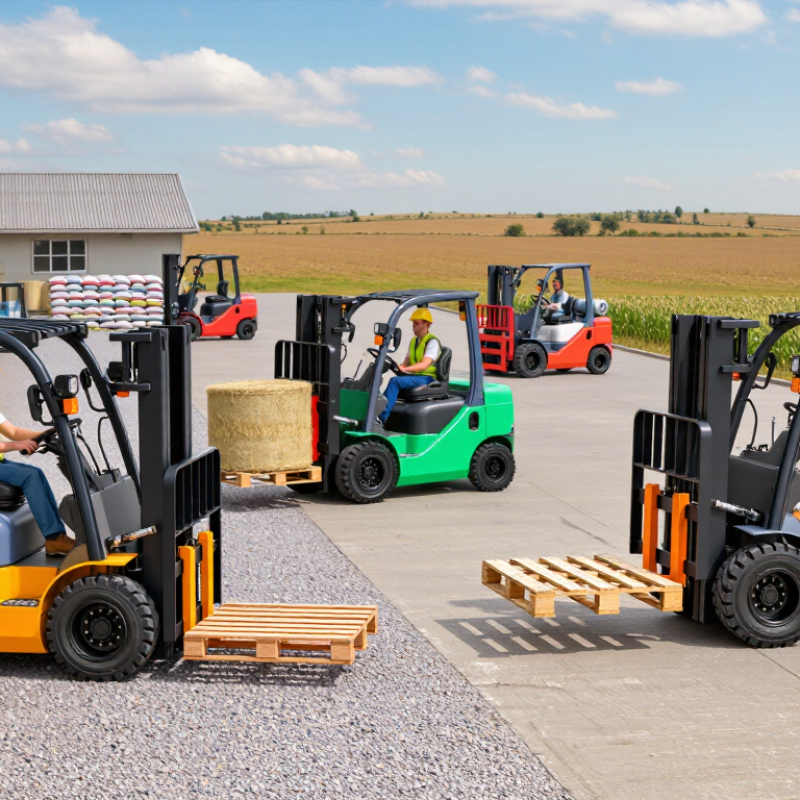
Define Farm Loads: Match Capacity, Load Center, and 3–6 m Lift Height
How to Choose the Best Agricultural Forklift?
Define Farm Loads: Match Capacity, Load Center, and 3–6 m Lift Height
Start with the real farm load, not its average weight. A wrapped bale may weigh 700 kilograms, while a fertilizer pallet can exceed 1,000 kilograms. Record weight, width, length, and whether the load shifts during travel. The load center matters just as much. A 1,000-kilogram load centered 600 millimeters from the forks is safer than the same load extending to 900 millimeters. OSHA’s powered industrial truck standard requires capacity plates to show rated capacity and load center. Read that plate at the intended lift height.
Lift height changes usable capacity. A forklift rated for 2,500 kilograms at low height may carry less at 4 or 5 meters. Mast design, attachment weight, and forward load position reduce residual capacity. Request a capacity chart covering 3–6 meters, not only the headline rating. Include the attachment in your calculation. A bale clamp or rotating fork adds weight and moves the load forward. Small details matter.
Measure the highest rack, trailer, or storage beam, then add clearance. Two hundred millimeters may prevent contact, though crowded yards make this easy to underestimate. HSE guidance reports that workplace transport incidents cause about one-quarter of vehicle-related workplace deaths in Great Britain. That statistic deserves attention. Choose capacity with a margin, but do not guess. Recheck seasonal loads; wet bales and overloaded pallets can quietly defeat a perfect-looking specification.
Compare Classes IV and V for 2.5–7-Ton Agricultural Applications
How to Choose the Best Agricultural Forklift?
For 2.5–7-ton agricultural work, Class IV and Class V trucks serve different ground conditions. Class IV uses cushion tires and suits smooth concrete floors, packing areas, and covered warehouses. Class V uses pneumatic tires and handles gravel, compacted soil, and uneven yards more effectively.
The Industrial Truck Association classification supports this basic distinction, but capacity labels can mislead. A 5-ton rating may apply only at a specific load center and mast height.
Farm loads are rarely uniform. A wet pallet of produce, a fertilizer bulk bag, or a long crate can shift the center of gravity. Check the capacity plate before comparing models. ANSI/ITSDF B56.1 requires rated-capacity information, while OSHA guidance emphasizes trained operators, inspections, and stable loads.
OSHA estimates that forklifts cause about 85 fatalities and 35,000 serious injuries annually in the United States. That figure makes daily inspection more than paperwork.
Class V is usually the safer practical choice outdoors, especially where tires meet mud, stones, or drainage channels. Class IV may reduce tire damage and turning effort on smooth floors.
However, choosing only by tire type is incomplete. Measure aisle width, ramp gradients, attachment weight, and typical load centers.
The neat answer is often wrong. Agricultural sites change after rain, harvest, and cleaning, so reassess the choice seasonally. A short trial with real loads can reveal problems that a specification sheet hides.
Choose Pneumatic Tires and Powertrains for Mud, Slopes, and 8–12% Grades
How to Choose the Best Agricultural Forklift?
Mud, slopes, and 8–12% grades demand more than lifting capacity. An 8% grade rises about 8 meters per 100 meters. A 12% grade rises about 12 meters. These slopes equal roughly 4.6–6.8 degrees, yet wet soil can feel much steeper.
Choose pneumatic tires when fields include ruts, loose gravel, or standing water. Their flexible sidewalls absorb impacts and improve contact on uneven ground. Solid tires resist punctures, but they can transmit more shock through the chassis. That matters when carrying fragile produce. The U.S. Occupational Safety and Health Administration requires loads to travel upgrade on ascending or descending grades above 10%, under OSHA 1910.178(n)(7). Operators should also follow the truck’s rated gradeability.
Powertrain selection should match the surface, not only the brochure’s horsepower. Four-wheel drive can improve traction across mud and sloped yards. A torque-focused transmission helps maintain controlled speed under load. Hydrostatic systems may offer smoother low-speed control, but they can lose efficiency when pushed continuously. I would test both systems with a loaded pallet. Empty trials mislead.
The 2023 FAO agricultural machinery outlook highlights rising mechanization needs amid labor shortages and harsher operating conditions. That supports practical durability, but one report cannot replace a site inspection. Measure the steepest route, check turning space, and test braking on wet ground. Small details decide safety. บาคาร่