
What Is an Inline Duct Fan Motor?
An Inline Duct Fan Motor sits inside a ventilation duct and drives the fan that moves air through it. It may look like a small component, but its speed, electrical demand, and compatibility affect how the whole system performs. In a home, that can mean steadier airflow through a bathroom or a long run of ductwork. In a workshop, it can influence ventilation where heat or odors build up. Small details matter.
The wider energy picture makes this component worth understanding. The International Energy Agency’s The Future of Cooling report projects that global electricity demand for space cooling could rise from about 2,000 terawatt-hours in 2016 to 6,200 terawatt-hours by 2050. That forecast covers cooling, not inline fans specifically, so it should not be treated as a fan-motor estimate. Still, it underscores why efficient air movement deserves attention. The U.S. Department of Energy’s Improving Fan System Performance sourcebook likewise recommends assessing fans as part of a system, including motors, controls, and airflow resistance.
That distinction is easy to miss. A motor’s rated power alone cannot tell you whether a fan will deliver the needed airflow in a particular duct. Duct length, bends, filters, and control settings all change operating conditions. This guide explains what an Inline Duct Fan Motor is, how it works, and which specifications matter when comparing options. It also covers common installation and maintenance considerations, such as mounting, vibration, and access for inspection. Real systems are rarely perfect; a careful selection still needs to match the actual duct layout and ventilation goal.
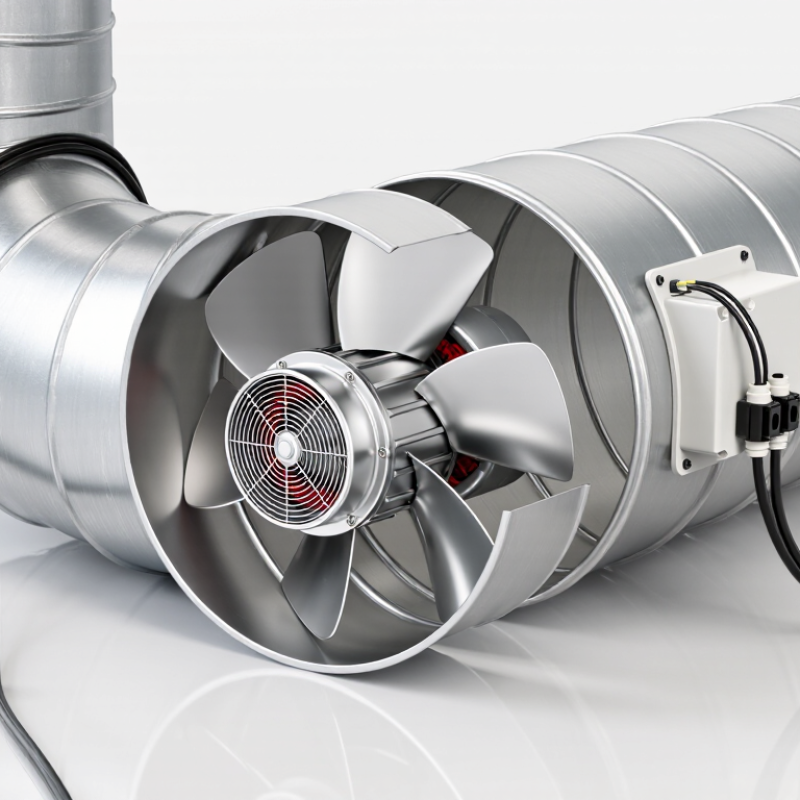
What an Inline Duct Fan Motor Is
An inline duct fan motor is the component that supplies the turning force inside a fan installed within a ventilation duct. It converts electrical energy into rotation, driving an impeller that moves air through the duct. The motor and impeller work together, but they are not the same part. The motor creates motion; the impeller shapes airflow. Air passes through. In many installations, the fan sits between duct sections, above a ceiling, or near an exhaust outlet. Its position can make access less convenient than it looks on a diagram.
Motor design affects how the fan performs. Some motors use alternating current, while others use direct current and electronic controls. Speed settings, electrical supply, bearing design, and the fan’s rated airflow all matter when selecting a replacement or planning a system. A motor that runs continuously may warm up, so its operating limits and ventilation requirements should be checked in the manufacturer’s technical documentation. It is easy to focus on wattage alone, though that can be misleading: a higher number does not automatically mean better airflow. I may be giving motor specifications too much attention; duct length, bends, and filters can also change the air reaching a room. A humming sound, unusual vibration, or reduced airflow can signal a problem, but each symptom needs careful inspection before a motor is blamed.
What Is an Inline Duct Fan Motor? - What an Inline Duct Fan Motor Is
| Dimension | Description | Why It Matters |
|---|---|---|
| Definition | An inline duct fan motor is the electric motor that turns the fan impeller inside a duct-mounted fan assembly. | The motor supplies the rotation needed to move air through a connected duct system. |
| Location | The motor is housed in or attached to the inline fan unit, which is installed along a duct run. | This arrangement keeps the fan in the duct path rather than at a room grille or wall opening. |
| Main components | Common components include the stator, rotor, bearings, electrical connections, and a shaft or motor support connected to the impeller. | The exact layout depends on the fan design; some assemblies use a directly coupled impeller. |
| Common motor designs | Inline fans may use AC induction motors, including permanent-split-capacitor designs, or electronically commutated (EC) motors. | Motor type affects control options, efficiency, electrical requirements, and service considerations. |
| Operating principle | Electrical energy creates a rotating magnetic field that turns the rotor and drives the fan impeller. | The impeller’s rotation produces airflow, while the duct system’s resistance influences the delivered airflow. |
| Speed control | Control methods vary by motor and fan. Some units support compatible speed controllers; EC models commonly use an electronic control input. | A controller must be compatible with the motor and follow the fan manufacturer’s wiring instructions. |
| Typical applications | Ducted ventilation, room exhaust, air transfer, and other applications specified for the particular fan model. | The fan must be selected for the required airflow, duct resistance, environment, and installation conditions. |
| Key selection checks | Check the fan’s airflow and pressure data, supply voltage, motor type, control compatibility, mounting requirements, and approved operating environment. | Published performance and installation instructions are model-specific; a motor’s suitability cannot be determined by duct size alone. |
| Maintenance considerations | Keep the fan and ductwork clear of excessive dust or obstructions, and inspect or service the unit according to its instructions. | Before inspection or cleaning, isolate electrical power and follow the unit’s safety and maintenance guidance. |
Specifications and features vary by fan model; consult the product documentation for exact electrical ratings, performance, controls, and maintenance requirements.