Choosing among China’s leading manufacturers and suppliers of dc motor magnets requires more than comparing prices and catalog specifications. A magnet that performs well at room temperature may lose strength inside a hot motor housing. Coating defects can also expose neodymium magnets to corrosion, particularly in humid operating environments. Details matter. Buyers need evidence covering magnetic properties, dimensional tolerances, thermal stability, and production consistency before approving a supplier.
Michael Faraday, whose electromagnetic rotation experiments helped establish the foundations of electric motors, expressed a useful principle: “Nothing is too wonderful to be true, if it be consistent with the laws of nature.” That principle encourages a practical approach to supplier claims: examine measurements and test results. For dc motor magnets, relevant evidence includes demagnetization curves, inspection records, and clearly defined operating temperatures. Ferrite can suit applications where cost and corrosion resistance outweigh compactness. Neodymium can support smaller designs, but grade selection must account for heat and demagnetizing fields. Material choice matters.
This guide examines Chinese suppliers through engineering capability, quality controls, customization options, and delivery reliability. Useful questions concern magnetization direction, arc dimensions, coating thickness, and traceability from raw material to finished shipment. Certifications provide context, yet they cannot establish whether a particular magnet suits your motor. Even an excellent sample leaves uncertainty about repeat orders. That deserves scrutiny. A credible shortlist should therefore distinguish documented capabilities from promotional claims while acknowledging where further testing remains necessary.
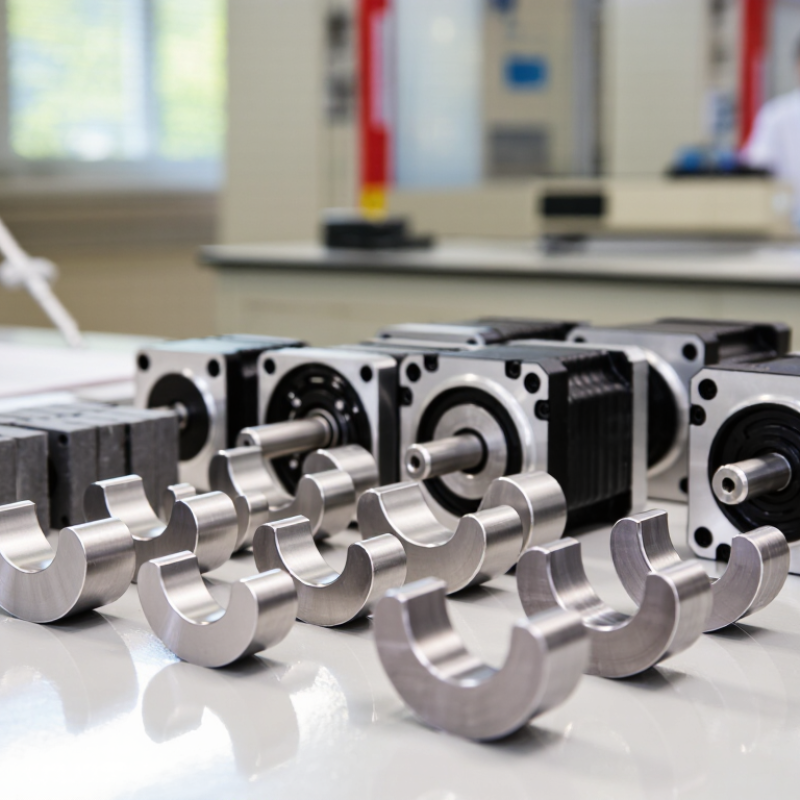
DC motor magnets create the steady magnetic field that interacts with winding current to produce torque. In brushed motors, permanent magnets usually sit inside the steel housing. In brushless designs, they typically form part of the rotor. Geometry matters. Arc segments fit cylindrical assemblies, while ring magnets can simplify positioning in compact motors. Uneven spacing or inconsistent magnetization can increase vibration and torque ripple, particularly at low speeds.
Ferrite magnets offer corrosion resistance and relatively low cost, but their lower magnetic strength often requires more space. Neodymium magnets support compact designs with high torque density. However, their temperature capability depends on grade, and corrosion protection often needs careful attention. Samarium cobalt handles demanding temperatures well, although cost and brittleness can limit its appeal. Stronger is not automatically better. A high-strength magnet can disappoint if the magnetic circuit saturates or the assembly process damages its edges.
When evaluating DC motor magnet manufacturers and suppliers in China, request measured properties, dimensional tolerances, and magnetization specifications. Check remanence, intrinsic coercivity, and performance at the intended operating temperature. Ask how coating quality and batch consistency are verified. Samples help. Still, a room-temperature sample test leaves uncertainty about repeated heating, vibration, and long-term exposure to moisture. A practical specification should reflect those conditions, even when tighter controls increase cost or extend production lead times.
Permanent magnets provide the magnetic field used to produce torque in permanent-magnet DC motors. This chart compares typical remanence ranges for five magnet material families. Remanence (Br), measured in tesla (T), describes the magnetic flux density remaining after the magnetizing field is removed.
Each floating bar spans a typical material range, rather than representing a single grade. NdFeB offers high remanence and can support compact motor designs, while ferrite is widely used for its affordability. Samarium cobalt is useful where thermal stability matters, and Alnico combines strong temperature stability with comparatively low resistance to demagnetization.
Remanence alone does not determine motor performance. Magnet selection also depends on coercivity, maximum energy product, operating temperature, corrosion resistance, air-gap geometry, and cost. Actual air-gap flux and torque depend on the complete motor design.
Data: representative material-family remanence ranges summarized in Wikipedia’s permanent magnet material comparison. Values are rounded reference ranges, not universal limits or supplier specifications; individual grades may fall outside these ranges.
Magnet material shapes torque, motor size, and temperature limits before a DC motor reaches production. Ferrite suits brushed DC motors in window regulators, small pumps, and ventilation fans. It offers corrosion resistance and economical production, but requires more volume than rare-earth alternatives for comparable magnetic output. Space becomes the tradeoff. For Chinese manufacturers and suppliers, useful specifications include magnetic grade, dimensional tolerances, and measured flux consistency.
NdFeB supports compact brushless DC motors in robotics, power tools, and electric vehicle auxiliaries. The U.S. Department of Energy’s 2022 Rare Earth Permanent Magnets Supply Chain Deep Dive Assessment highlights its high energy density. Stronger magnets can support smaller rotors, although winding design and cooling still constrain continuous torque. Heat matters. A grade selected from room-temperature data may lose performance inside a hot, enclosed housing. Engineers should check demagnetization curves at operating temperature, particularly under high opposing fields during overloads. Coatings need checking.
Samarium-cobalt deserves consideration in DC motors exposed to sustained heat, despite its cost and brittleness. It is not automatically the better choice; assembly damage can undermine its thermal advantages. Supply also influences material selection. The USGS Mineral Commodity Summaries 2024 estimated China’s 2023 rare-earth mine production at 240,000 tonnes, against 350,000 tonnes worldwide. Those figures describe upstream supply, rather than finished magnet quality. Buyers still need batch traceability, temperature-specific magnetic measurements, and inspection results for chips, cracks, and coating coverage.
China’s DC motor magnet supply chain connects rare earth processing centers with specialized coastal manufacturing clusters. Baotou in Inner Mongolia and Ganzhou in Jiangxi are important upstream rare earth industry hubs. Ningbo and surrounding Zhejiang cities have established capabilities in permanent magnet production, machining, and export logistics. Regional strengths differ. A supplier’s address alone does not establish its production capabilities or material traceability.
For sintered neodymium magnets, production typically involves alloy preparation, powder processing, pressing, sintering, machining, coating, and magnetization. These operations may involve several companies, even when buyers purchase through one supplier.
Ferrite magnets follow a different material route, generally using iron oxide with strontium or barium compounds. They remain practical for many cost-sensitive DC motors, although their lower magnetic strength affects motor design. Check the handoffs. Outsourced coating or grinding can introduce variation unless inspection responsibilities and acceptance criteria are clearly documented.
When evaluating suppliers, request dimensional reports, magnetic property data, coating specifications, and batch identification records. For arc magnets, drawings should define inner radius, outer radius, thickness, and magnetization direction.
Maximum operating temperature needs careful review because demagnetization resistance depends on both material grade and the motor’s magnetic circuit.
A clean sample is encouraging, but it does not prove consistent volume production. Buyers can overlook this distinction when delivery schedules become tight. Retained samples and repeat-order inspection data provide a firmer basis for comparing suppliers than polished factory photographs.
Evaluating Chinese DC motor magnet manufacturers starts with matching magnetic properties to actual operating conditions. Ask for remanence, coercivity, dimensional tolerances, and the recommended operating temperature for the proposed grade. Material choice matters. Ferrite may suit cost-sensitive designs, while neodymium can support compact motors requiring stronger magnetic fields. Neither material guarantees better performance without considering motor geometry, current, and heat. Request test data at your expected operating temperature, rather than relying only on room-temperature specifications.
Manufacturing consistency deserves close attention when comparing suppliers. For arc magnets, review thickness, radius, magnetization direction, and batch traceability. A dimensional inspection report should identify measurement methods and sampling quantities. Check the evidence. An ISO 9001 certificate supports quality-system assessment, but does not establish whether a magnet meets your motor’s requirements. Verify its scope and validity independently. For coated neodymium magnets, request corrosion-testing conditions and acceptance criteria relevant to the intended environment.
Supplier evaluation should also examine sample approval, packaging, production capacity, and responses to technical questions. Ask whether production orders use the same material specifications and inspection controls as approved samples. A perfect-looking sample can create false confidence; I would still request results from several production batches before approving volume purchases. That approach adds time and expense, which smaller projects may struggle to justify. Where budgets are limited, prioritize checks tied to likely failures, including thermal demagnetization, coating damage, and dimensional variation.
Technical and quality criteria for assessing permanent magnets used in brushed DC and brushless DC motors, including sourcing from China.
| Evaluation Criterion | Data or Evidence to Request | Technical Reference or Evaluation Basis | Why It Matters for DC Motors |
|---|---|---|---|
| Magnet Material Selection | Material family, manufacturing route, magnetic grade, and application-specific material data. | Common permanent-magnet materials include sintered or bonded neodymium-iron-boron (NdFeB), hard ferrite, and samarium-cobalt (SmCo). These materials differ in magnetic strength, temperature behavior, corrosion resistance, and cost. | Material choice affects motor size, torque capability, operating temperature, and overall cost. |
| Remanence and Energy Product | Remanence Br, maximum energy product (BH)max, test temperature, and lot-level magnetic test results. | Br is commonly reported in tesla (T); (BH)max is reported in kJ/m³ or MGOe. 1 MGOe ≈ 7.958 kJ/m³. IEC 60404-5 describes methods for measuring permanent-magnet material properties. | These properties support material comparison and electromagnetic design. Actual air-gap flux also depends on geometry and the magnetic circuit. |
| Resistance to Demagnetization | Intrinsic coercivity HcJ, normal coercivity HcB, and demagnetization curves at relevant temperatures. | Coercivity is commonly expressed in kA/m or kOe. 1 kOe ≈ 79.577 kA/m. HcJ and HcB describe different properties and should be identified separately in technical documentation. | Insufficient demagnetization resistance can cause permanent flux loss under high temperature, high current, or fault conditions. |
| Temperature Capability | Temperature-dependent magnetic curves, reversible temperature coefficients, and irreversible flux-loss test results. | Maximum usable temperature depends on material grade, magnet geometry, magnetic circuit, opposing field, and allowable irreversible loss. Curie temperature is a material property and does not define the safe operating temperature of a motor magnet. | Temperature validation helps preserve torque and back electromotive force throughout the intended operating range. |
| Dimensions and Arc Geometry | Inspection reports for thickness, length, inner and outer radius, arc angle, chamfers, and drawing tolerances. | Use the approved engineering drawing to define acceptance. ISO 1101 provides a framework for geometrical tolerancing; ISO 14253-1 addresses decision rules for verifying conformity with dimensional and geometrical specifications. | Dimensional variation affects air-gap consistency, assembly fit, rotor balance, and local flux distribution. |
| Magnetization and Pole Pattern | Magnetization direction, pole count, polarity map, surface-field measurements, and total magnetic flux where applicable. | Motor magnets may use parallel, radial, diametrical, or multipole magnetization, depending on design. Surface-field results require a defined probe position, orientation, measurement distance, and fixture. | Incorrect polarity or magnetization orientation can reduce torque, increase torque ripple, or prevent correct operation. |
| Coating and Corrosion Protection | Coating system, thickness, adhesion requirements, and corrosion-test reports with exposure conditions and acceptance criteria. | NdFeB magnets commonly require corrosion protection. ISO 9227 specifies salt-spray test methods. Salt-spray exposure hours do not directly predict service life in a motor. | Corrosion can damage magnet surfaces, weaken adhesive interfaces, and generate contamination inside the motor. |
| Mechanical Integrity and Retention | Limits for chips and cracks, handling controls, adhesive compatibility data, and assembly-level retention validation. | Sintered permanent magnets are brittle. Acceptable edge defects and retention requirements should be specified on drawings or in an agreed inspection standard. Rotating assemblies require validation at their specified speed and temperature conditions. | Mechanical damage or inadequate retention can cause magnet movement, rotor contact, or assembly failure. |
| Quality Management System | Current certification, certificate scope, covered manufacturing sites, audit findings, and corrective-action records. | ISO 9001 defines quality management system requirements. IATF 16949 adds automotive-sector requirements where applicable. Certification scope should cover the relevant facility and activities. | A verified quality system supports process control, documented responsibilities, and consistent handling of nonconforming material. |
| Production Consistency | Lot distributions for critical properties, measurement-system studies, control plans, and process-capability results. | Cp and Cpk compare process variation with specification limits. Their interpretation requires a stable process and suitable measurement data; an acceptance threshold must be agreed with the customer. | Consistent dimensions and magnetic output reduce variation in motor torque, speed, noise, and assembly yield. |
| Restricted Substances | Product-specific material declarations and test reports covering the magnet, coatings, and other supplied materials. | EU RoHS Directive 2011/65/EU, as amended, restricts specified substances in applicable electrical and electronic equipment. IEC 62321 provides methods for determining certain substances. REACH Regulation (EC) No 1907/2006 may also create supply-chain obligations. | Applicable substance requirements affect market access and customer documentation. Compliance must reflect the actual supplied material and intended use. |
| Traceability and Change Control | Lot identifiers, inspection records, material links, retained samples where agreed, and documented change-notification procedures. | Traceability should connect supplied magnets with relevant production and inspection records. Changes to material grade, coating, tooling, manufacturing location, or processing should follow agreed approval requirements. | Traceability supports defect investigation and containment; change control helps prevent unvalidated changes in motor performance. |
| Capacity and Delivery Reliability | Demonstrated output for the required part, bottleneck capacity, historical delivery records, minimum order quantities, and production lead times. | Evaluate capacity for the actual material, geometry, coating, and magnetization process. Define on-time delivery using an agreed delivery date and measurement period. | Evidence of relevant capacity and delivery performance helps assess whether a supplier can support planned production volumes. |
Sourcing DC motor magnets from manufacturers and suppliers in China starts with a drawing, rather than a price list. Specify material, dimensions, magnetization direction, operating temperature, and annual demand. For arc magnets, include inner radius, outer radius, arc angle, and thickness. A ±0.05 mm thickness tolerance may suit some assemblies, but confirm it against your actual air gap. Temperature matters. A neodymium grade’s room-temperature strength alone cannot establish its resistance to demagnetization inside a hot motor. Request demagnetization curves at your expected operating temperature.
Tips: Approve samples using the same drawing revision intended for production. Keep one accepted sample for comparison. Check polarity before assembly. A simple fixture can catch reversed magnetization before adhesive curing makes correction expensive.
Quality checks should cover dimensions, magnetic properties, coating condition, and batch traceability. Ask how the supplier measures flux and controls measurement distance. Readings from different fixtures may be misleading. For coated magnets, agree on corrosion-test conditions and acceptance criteria before ordering. Salt-spray hours alone do not predict service life. A weakness in sample approval is that a small batch may hide production variation. Consider a pilot lot. Confirm whether quoted lead time includes tooling, coating, inspection, and export packing. Require separators and protective packaging appropriate to the magnet strength and shipping method. Put dispatch dates and inspection-document requirements into the purchase order.